
Electricity can be a significant operating expense for businesses, particularly for facilities that run machinery, cooling systems, lighting, or other equipment for long hours. When electricity consumption is high, even a small change in the cost per unit can affect monthly expenses.
This is one reason solar power for businesses is receiving more attention. By generating electricity on-site, a business can meet part of its power requirement through solar instead of depending entirely on electricity from the grid. The actual savings will depend on the size of the system, energy consumption, tariff structure, sunlight, and operating hours.
Why Are Businesses Switching to Solar Power?
For many firms, the choice of installing solar is dependent on the electricity bill. If a company consumes large amounts of power regularly, generating at least some of this power in-house would mean lower costs since there will be less power to be bought from outside sources.
Another benefit that comes from using solar is planning. Electricity tariffs can vary over time, making it hard for any business to estimate its future costs. Installing solar panels will not remove this element of unpredictability, but the ability to generate some of the needed power means having more control over part of the budget.
The suitability of solar energy depends on the type of business. For instance, an office that uses large amounts of power during daylight hours will have a different demand from a factory working around the clock.
For this reason, businesses should look at solar energy for businesses as a project that needs proper assessment rather than simply choosing a system based on its capacity.
How Solar Energy Helps Reduce Commercial Electricity Bills
Solar panels generate electricity during daylight hours, allowing businesses to use that power for their regular operations. Offices may use solar generation for lighting, computers, air conditioning, and other equipment, while commercial facilities can apply it to their operational loads.
The greater the overlap between solar generation and daytime electricity consumption, the more opportunity there may be to use the generated power directly.
The financial benefit depends on the business’s electricity tariff and consumption pattern. A facility with substantial daytime demand may see a different result from one that uses most of its electricity at night.
With suitable planning, commercial solar power can therefore become part of a business’s strategy for managing recurring electricity expenses while also increasing its use of renewable energy.
Solar Solutions for Factories, Offices & Commercial Properties
Each business entity has varied power needs, and the installation of a solar panel would depend on the operational pattern of each property. An office would need the most energy during its working hours, whereas a factory will have its own machines and production equipment which might require energy. In commercial buildings, the space available on the rooftop, the amount of energy consumed, operating hours, and electrical setup are important considerations to start with.
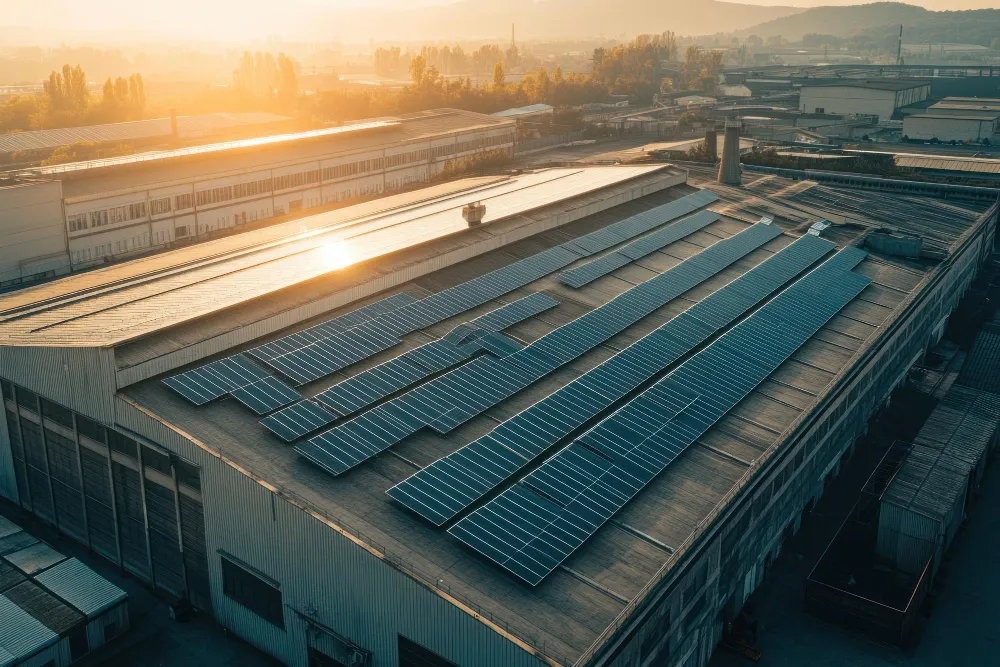
Factories often have larger and more consistent electricity requirements. Industrial solar solutions can be designed after assessing the facility’s load profile, machinery, working shifts, roof or ground space, and other site conditions. The system does not have to meet the entire electricity requirement to be useful. Even offsetting a portion of grid consumption can contribute to lower operating costs over time.
Understanding Solar ROI and Long-Term Cost Savings for Businesses
Installing solar involves an upfront investment, so businesses need to look at the expected return over the system’s operating life. The potential financial return depends on factors such as system cost, electricity consumption, generation, tariffs, maintenance, and applicable incentives or billing arrangements.
A simple comparison can begin with the current monthly electricity expense and the estimated value of the electricity that the solar system could generate. Businesses can then consider the initial investment to understand the approximate payback period.
For example, if a system generates electricity worth ₹50,000 a month and the project costs ₹30 lakh, a basic payback calculation would put the period at around five years. This is only an illustration; actual calculations should account for changing tariffs, system performance, maintenance, financing, and other project costs.
How to Choose the Right Commercial or Industrial Solar System
The right system is not necessarily the largest one. Businesses should first understand their electricity consumption and identify when the highest demand occurs.
Consider these factors before choosing a system:
- Current and expected electricity consumption
- Available roof or ground space
- Daytime and nighttime load patterns
- Equipment and electrical infrastructure
- Local sunlight and site conditions
- Installation, maintenance, and financing costs
For facilities with substantial energy demand, industrial solar power systems may require more detailed engineering and planning. Businesses should also compare equipment quality, installation experience, warranties, monitoring, and after-sales support.
Conclusion
An appropriately evaluated solar project enables a business to make better use of renewable energy without forgetting the future economic aspect. What is essential to remember is that the aim of most companies is not only to set up a solar power plant, but rather to choose one that suits the needs of the firm.
Before taking any steps forward, a company must analyze its power usage, space for installations, working hours, generation forecast, and overall cost of the project. Solar power for businesses can be particularly useful when the system is matched to actual energy requirements rather than simply selected for maximum capacity.
In the long run, a well-designed solar system can support lower electricity expenses while helping businesses move towards a more sustainable energy model.